Springer Nature
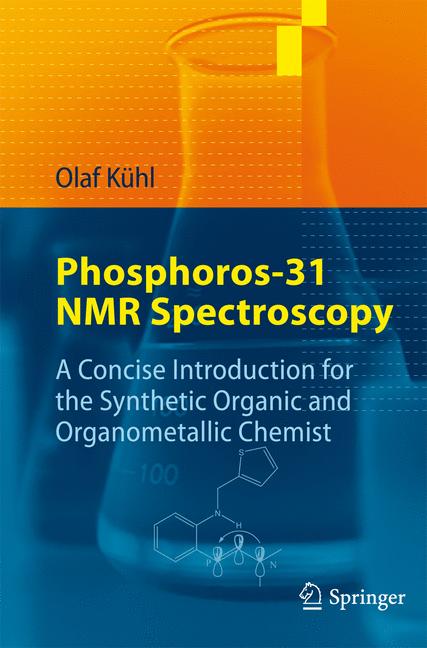
Phosphorus-31 Nmr Spectroscopy
Miglior prezzo disponibile
59,99$
Springer Nature · Spedizione gratuita
VISAPayPal
Prezzi aggiornati
Specifiche
MarcaSpringer Nature
CondizioneNuovo
Descrizione
Nuclear Magnetic Resonance is a powerful tool, especially for the identification of 1 13 hitherto unknown organic compounds. H- and C-NMR spectroscopy is known and applied by virtually every synthetically working Organic Chemist. Con- quently, the factors governing the differences in chemical shift values, based on chemical environment, bonding, temperature, solvent, pH, etc. , are well understood, and specialty methods developed for almost every conceivable structural challenge. Proton and carbon NMR spectroscopy is part of most bachelors degree courses, with advanced methods integrated into masters degree and other graduate courses. In view of this universal knowledge about proton and carbon NMR spectr- copy within the chemical community, it is remarkable that heteronuclear NMR is still looked upon as something of a curiosity. Admittedly, most organic compounds contain only nitrogen, oxygen, and sulfur atoms, as well as the obligatory hydrogen and carbon atoms, elements that have an unfavourable isotope distribution when it comes to NMR spectroscopy. Each of these three elements has a dominant isotope: 14 16 32 16 32 N (99. 63% natural abundance), O (99. 76%), and S (95. 02%), with O, S, and 34 14 S (4. 21%) NMR silent. N has a nuclear moment I = 1 and a sizeable quadrupolar moment that makes the NMR signals usually very broad and dif cult to analyse.
Storico prezzi
Ricevi una notifica se il prezzo scende
Ti invieremo un'email quando il prezzo di questo prodotto diminuirà.
- Aggiornamenti dei prezzi in tempo reale
- Oltre 50 negozi monitorati
- Avvisi gratuiti di calo prezzo
- Solo negozi verificati
Avvisami quando il prezzo scende sotto: 59,99$
Prodotti simili
Una selezione di prodotti che potrebbero interessarti. Guarda tutti
 15N-NMR Spectroscopy
109,99$
15N-NMR Spectroscopy
109,99$
 Dynamic Nmr Spectroscopy
169,99$
Dynamic Nmr Spectroscopy
169,99$
 Nmr Spectroscopy Of Annulenes
39,99$
Nmr Spectroscopy Of Annulenes
39,99$
 Nmr Spectroscopy Of Polymers
99,99$
Nmr Spectroscopy Of Polymers
99,99$
 Hyperpolarization Methods In Nmr Spectroscopy
219,99$
Hyperpolarization Methods In Nmr Spectroscopy
219,99$
 Fundamentals Of Protein Nmr Spectroscopy
139,99$
Fundamentals Of Protein Nmr Spectroscopy
139,99$
 The Practice Of Nmr Spectroscopy
54,99$
The Practice Of Nmr Spectroscopy
54,99$
 Nmr Spectroscopy In Organic Chemistry
54,99$
Nmr Spectroscopy In Organic Chemistry
54,99$