Springer Nature
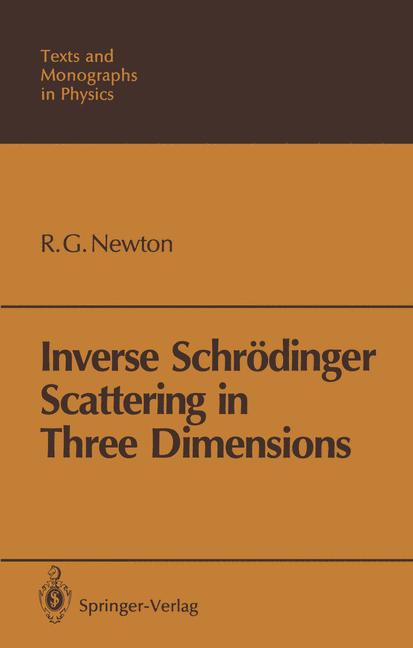
Inverse SchröDinger Scattering In Three Dimensions
Miglior prezzo disponibile
52,74€
Springer Nature · Spedizione gratuita
VISAPayPal
Prezzi aggiornati
Specifiche
MarcaSpringer Nature
CondizioneNuovo
Descrizione
Most of the laws of physics are expressed in the form of differential equations; that is our legacy from Isaac Newton. The customary separation of the laws of nature from contingent boundary or initial conditions, which has become part of our physical intuition, is both based on and expressed in the properties of solutions of differential equations. Within these equations we make a further distinction: that between what in mechanics are called the equations of motion on the one hand and the specific forces and shapes on the other. The latter enter as given functions into the former. In most observations and experiments the "equations of motion," i. e. , the structure of the differential equations, are taken for granted and it is the form and the details of the forces that are under investigation. The method by which we learn what the shapes of objects and the forces between them are when they are too small, too large, too remote, or too inaccessi ble for direct experimentation, is to observe their detectable effects. The question then is how to infer these properties from observational data. For the theoreti cal physicist, the calculation of observable consequences from given differential equations with known or assumed forces and shapes or boundary conditions is the standard task of solving a "direct problem. " Comparison of the results with experiments confronts the theoretical predictions with nature.
Storico prezzi
Ricevi una notifica se il prezzo scende
Ti invieremo un'email quando il prezzo di questo prodotto diminuirà.
- Aggiornamenti dei prezzi in tempo reale
- Oltre 50 negozi monitorati
- Avvisi gratuiti di calo prezzo
- Solo negozi verificati
Avvisami quando il prezzo scende sotto: 52,74€
Prodotti simili
Una selezione di prodotti che potrebbero interessarti. Guarda tutti
 Direct And Inverse Scattering For The Matrix SchröDinger Equation
106,99€
Direct And Inverse Scattering For The Matrix SchröDinger Equation
106,99€
 SchröDinger Equations In Nonlinear Systems
189,89€
SchröDinger Equations In Nonlinear Systems
189,89€
 Nonlinear Fractional SchröDinger Equations In R^N
68,56€
Nonlinear Fractional SchröDinger Equations In R^N
68,56€
 Part 1 SchröDinger In Vienna And Zurich 1887â1925
348,14€
Part 1 SchröDinger In Vienna And Zurich 1887â1925
348,14€
 Inverse Problems In Scattering
158,24€
Inverse Problems In Scattering
158,24€
 Inverse Scattering Problems In Optics
52,74€
Inverse Scattering Problems In Optics
52,74€
 Inverse Problems In Quantum Scattering Theory
52,74€
Inverse Problems In Quantum Scattering Theory
52,74€
 Qualitative Methods In Inverse Scattering Theory
84,35€
Qualitative Methods In Inverse Scattering Theory
84,35€