Springer Nature
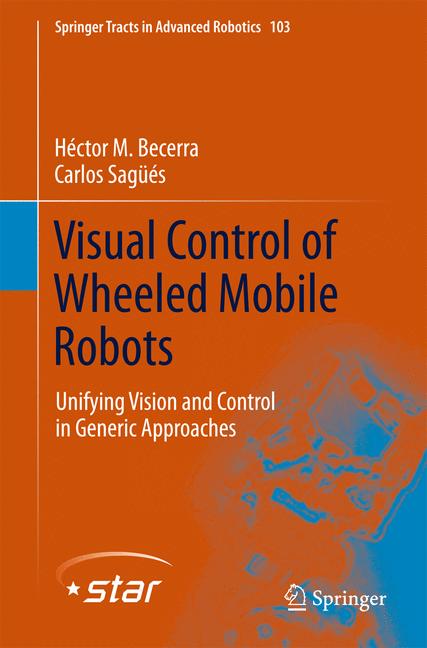
Visual Control Of Wheeled Mobile Robots
Miglior prezzo disponibile
139,99$
Springer Nature · Spedizione gratuita
VISAPayPal
Prezzi aggiornati
Specifiche
MarcaSpringer Nature
CondizioneNuovo
Descrizione
Vision-based control of wheeled mobile robots is an interesting field of research from a scientific and even social point of view due to its potential applicability. This book presents a formal treatment of some aspects of control theory applied to the problem of vision-based pose regulation of wheeled mobile robots. In this problem, the robot has to reach a desired position and orientation, which are specified by a target image. It is faced in such a way that vision and control are unified to achieve stability of the closed loop, a large region of convergence, without local minima and good robustness against parametric uncertainty. Three different control schemes that rely on monocular vision as unique sensor are presented and evaluated experimentally. A common benefit of these approaches is that they are valid for imaging systems obeying approximately a central projection model, e.g., conventional cameras, catadioptric systems and some fisheye cameras. Thus, the presented control schemes are generic approaches. A minimum set of visual measurements, integrated in adequate task functions, are taken from a geometric constraint imposed between corresponding image features. Particularly, the epipolar geometry and the trifocal tensor are exploited since they can be used for generic scenes. A detailed experimental evaluation is presented for each control scheme.
Storico prezzi
Ricevi una notifica se il prezzo scende
Ti invieremo un'email quando il prezzo di questo prodotto diminuirà.
- Aggiornamenti dei prezzi in tempo reale
- Oltre 50 negozi monitorati
- Avvisi gratuiti di calo prezzo
- Solo negozi verificati
Avvisami quando il prezzo scende sotto: 139,99$
Prodotti simili
Una selezione di prodotti che potrebbero interessarti. Guarda tutti
 Visual Control Of Wheeled Mobile Robots
84,99$
Visual Control Of Wheeled Mobile Robots
84,99$
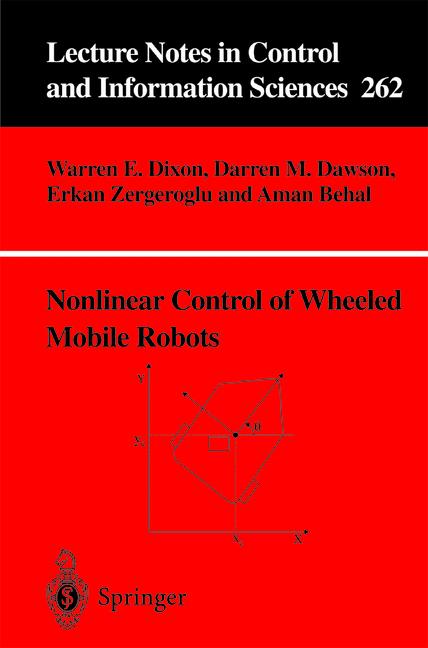 Nonlinear Control Of Wheeled Mobile Robots
84,99$
Nonlinear Control Of Wheeled Mobile Robots
84,99$
 Whole-Body Impedance Control Of Wheeled Humanoid Robots
84,99$
Whole-Body Impedance Control Of Wheeled Humanoid Robots
84,99$
 Advances In Control Of Articulated And Mobile Robots
169,99$
Advances In Control Of Articulated And Mobile Robots
169,99$
 Wheeled Mobile Robot Control
169,99$
Wheeled Mobile Robot Control
169,99$
 Robust Control Of Robots
109,99$
Robust Control Of Robots
109,99$
 Visual Perception For Humanoid Robots
109,99$
Visual Perception For Humanoid Robots
109,99$
 Control Of Manipulation Robots
54,99$
Control Of Manipulation Robots
54,99$