
Des CaractèRes Anatomiques Des Grands Singes Pseudo-Anthropomorphes Duvernoy (Louis Georges) Livres D'histoire Naturelle
Miglior prezzo disponibile
4973,38$
AbeBooks · Spedizione gratuita
VISAPayPal
Prezzi aggiornati
Specifiche
CondizioneNuovo
Descrizione
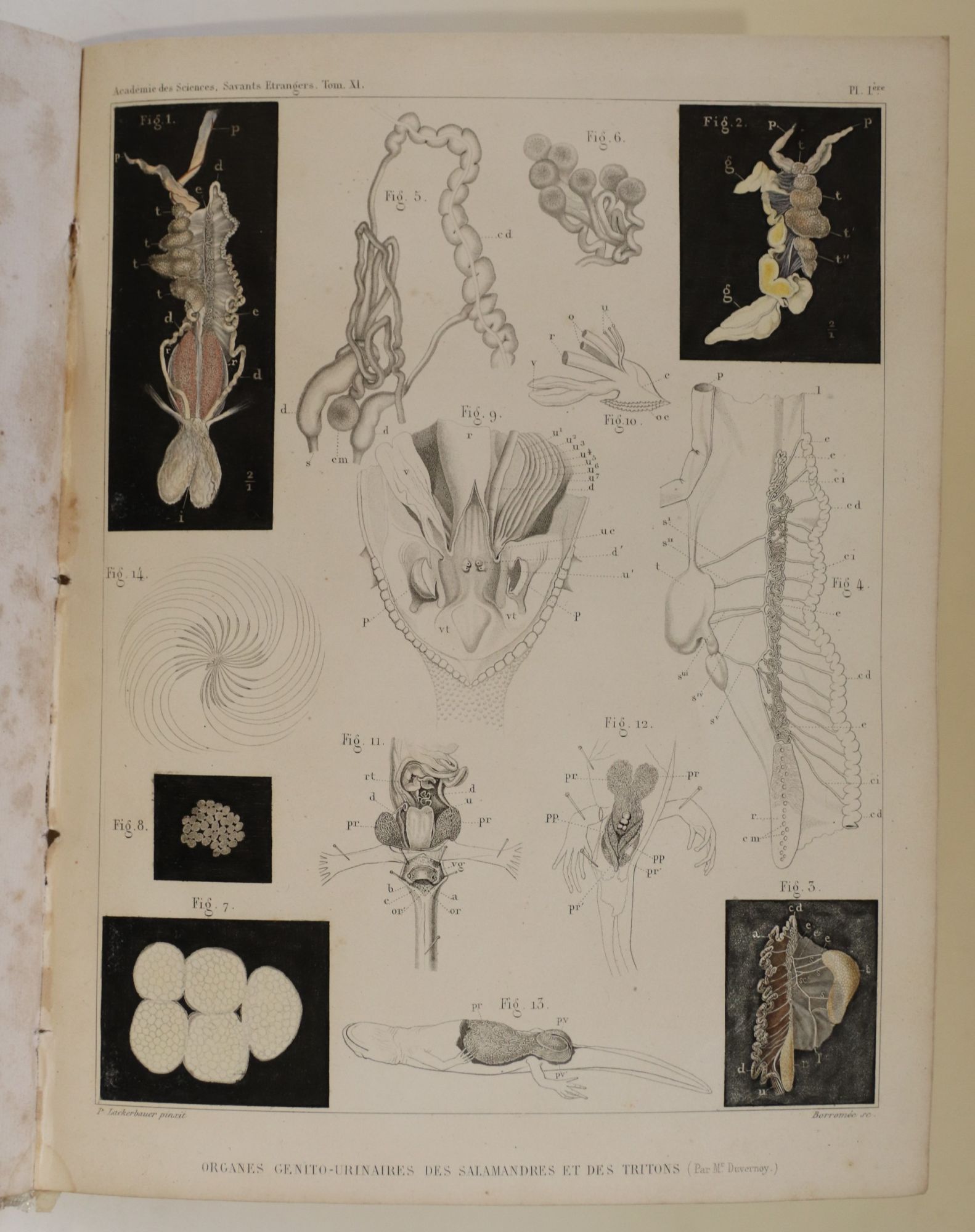
Paris, Gide & Baudry, [1855-1856]. 4°, 272 pages and 16 plates ; modern paperboards (original front cover preserved). Very rare offprint of the first complete anatomy of the gorilla and the first general comparative anatomy of the great apes. The gorilla was discovered in 1846 and first scientifically described in 1847 by Thomas Savage and Jeffries Wyman in the Boston Journal of Natural History. A few years later, Richard Owen published an important paper in 1851 comparing the skulls of the orangutan, the chimpanzee and the gorilla. During the same period, in France, Blainville published two lithographed plates depicting the skeleton and skull of a gorilla in his Ostéographie (1849). However, « in 1851 the Muséum d'histoire naturelle gazumped the rest of Europe in this new field of study by receiving the first two whole gorilla bodies seen in the West. Preserved in alcohol and shipped back from Gabon by Captain Penaud of the Eldorado, these were a baby of the species (boarded as a live passenger, then embalmed in liquid after its sad demise), and a full-grown male specimen that had been secured by M. Franquet, a French naval doctor. » (Dr Ted Gott, « Stowed Away : Emmanuel Frémiet's Gorilla carrying off a woman », NGV, Art Journal, no. 45, 23 May 2014.) Thanks to these two exceptional specimens, Duvernoy was able to describe fully not only the general anatomy and osteology of the gorilla, but also its myology and ENT anatomy, and the anatomy of the male reproductive system. In addition, he systematically compared the gorilla's anatomy with those of the orangutan, chimpanzee and gibbon. The results of his research were first published in the paper entitled Des caractères anatomiques des grands singes pseudo-anthropomorphes. This illustration of this paper is also exceptional. The plates were engraved by Formant after his own drawings (plates 1-4 and 16), by Lackerbauer after his own photographs (plates 5-6), by Lackerbauer after drawings by Werner (plates 7-13), and by Lackerbauer after his own drawings (plates 14-15). Henri Formant (1827-1904) entered the Muséum d'histoire naturelle in 1846 to work in the « Atelier des moulages ». He was nominated « peintre de l'atelier de moulage » in March 1849. Pierre Lackerbauer (1823-1872) was a pioneer photographer in sciences and medicine, and combined the art of lithography and photography. The Muséum painter Jacques-Christophe Werner (1798-1856) is very famous for his illustration of Levaillant and Temminck's Birds but also Blainville's Ostéographie and Histoire naturelle des mammifères. This is an offprint issue and not an extract from volume VIII of the Archives du Muséum. It does not have a separate pagination like in most cases, because Duvernoy's paper was printed at the very beginning of volume VIII on pages 1-272. Therefore, the publisher did not have to renumber the offprint issue, which has one distinctive feature : an intermediary cover without the number and general title of the volume. WorldCat lists only 5 copies : Muséum d'histoire naturelle (France) ; Universitätsbibliothek J. C. Senckenberg and Philosophisch-Theologische Hochschule Sankt Georgen Bibliothek (Germany) ; Cornell University Library and National Library of Medicine (USA).
Storico prezzi
Ricevi una notifica se il prezzo scende
Ti invieremo un'email quando il prezzo di questo prodotto diminuirà.
- Aggiornamenti dei prezzi in tempo reale
- Oltre 50 negozi monitorati
- Avvisi gratuiti di calo prezzo
- Solo negozi verificati
Avvisami quando il prezzo scende sotto: 4973,38$
Prodotti simili
Una selezione di prodotti che potrebbero interessarti.
 Fragments Sur Les Organes GéNito-Urinaires Des Reptiles Et Leurs Produits Duvernoy (Georges-Louis) Livres D'histoire Naturelle
165,78$
Fragments Sur Les Organes GéNito-Urinaires Des Reptiles Et Leurs Produits Duvernoy (Georges-Louis) Livres D'histoire Naturelle
165,78$
 MéMoires Sur Le SystèMe Nerveux Des Mollusques AcéPhales Lamellibranches Ou Bivalves Duvernoy (Georges Louis) Livres D'histoire Naturelle
773,64$
MéMoires Sur Le SystèMe Nerveux Des Mollusques AcéPhales Lamellibranches Ou Bivalves Duvernoy (Georges Louis) Livres D'histoire Naturelle
773,64$
 Quelques Observations Sur Le Canal Alimentaire Des SemnopithèQues Et Description D'un Sphincter Å"Sophagien Du Diaphragme Dans Ses Animaux Et Dans Plusieurs Autres Genres De Singes Duvernoy (Georges-Louis) Livres D'histoire Naturelle
165,78$
Quelques Observations Sur Le Canal Alimentaire Des SemnopithèQues Et Description D'un Sphincter Å"Sophagien Du Diaphragme Dans Ses Animaux Et Dans Plusieurs Autres Genres De Singes Duvernoy (Georges-Louis) Livres D'histoire Naturelle
165,78$
 MéMoire Sur Quelques ParticularitéS Des Organes De La DéGlutition De La Classe Des Oiseaux Et Des Reptiles Pour Servir De Suite à Un Premier MéMoire Sur La Langue Duvernoy (Georges-Louis) Livres D'histoire Naturelle
165,78$
MéMoire Sur Quelques ParticularitéS Des Organes De La DéGlutition De La Classe Des Oiseaux Et Des Reptiles Pour Servir De Suite à Un Premier MéMoire Sur La Langue Duvernoy (Georges-Louis) Livres D'histoire Naturelle
165,78$
 Discours Prononcé Le 22 DéCembre 1827 à L'ouverture Du Cours D'histoire Naturelle De La Faculté Des Sciences De Strasbourg. [Relié à La Suite :] - Discours De Cloture Du Cours D'histoire Naturelle De La Faculté Des Sciences De Strasbourg Prononcé Le 30 Juillet 1828 Duvernoy, Georges-Louis * Natural History, Geology, Mineralogy
276,30$
Discours Prononcé Le 22 DéCembre 1827 à L'ouverture Du Cours D'histoire Naturelle De La Faculté Des Sciences De Strasbourg. [Relié à La Suite :] - Discours De Cloture Du Cours D'histoire Naturelle De La Faculté Des Sciences De Strasbourg Prononcé Le 30 Juillet 1828 Duvernoy, Georges-Louis * Natural History, Geology, Mineralogy
276,30$